Category: Indian Constitution

  • 🇮🇳 The Three Pillars of the Indian Constitution: The Power Trio That Runs India

    🇮🇳 The Three Pillars of the Indian Constitution: The Power Trio That Runs India

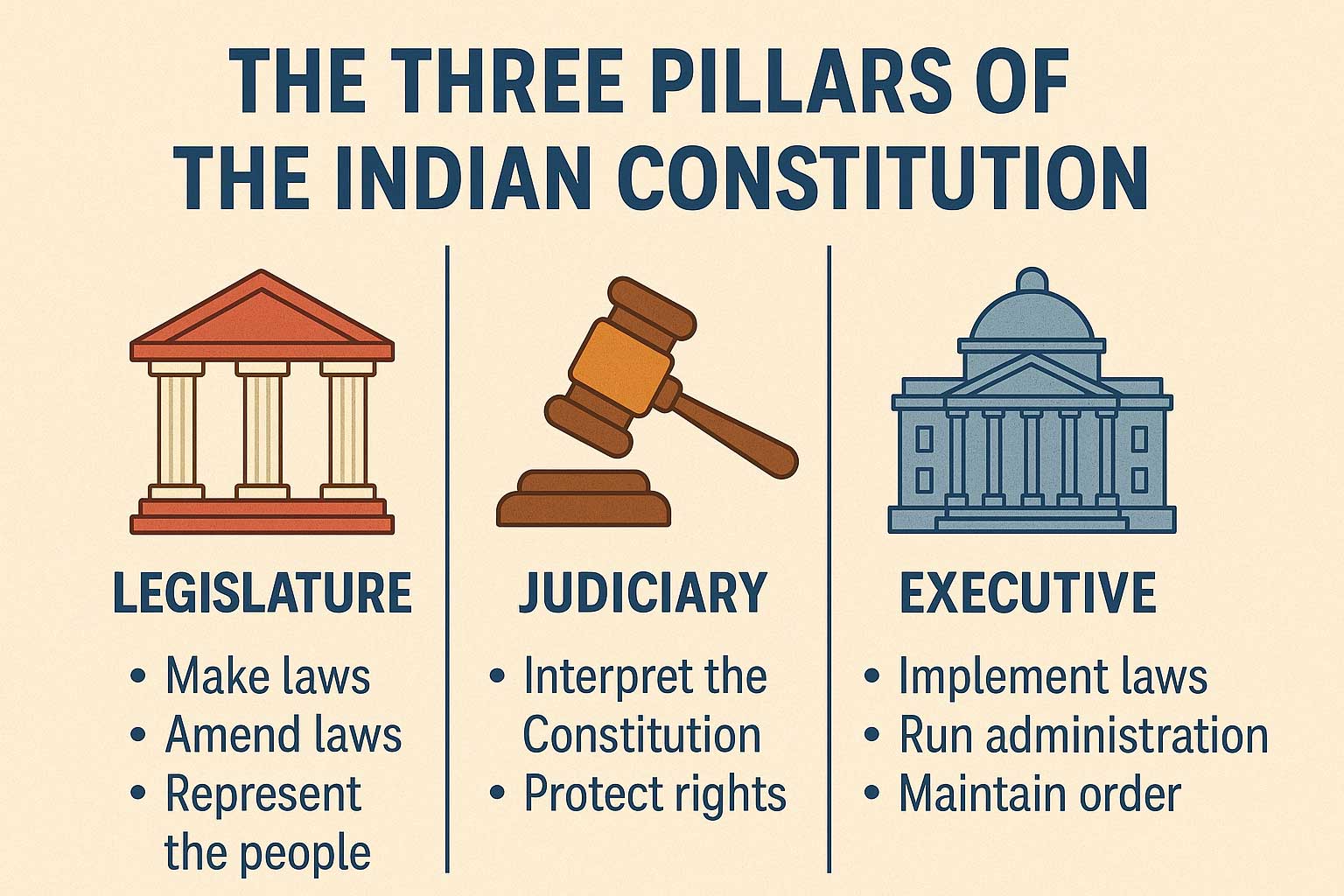
    If the Indian Constitution were directing a movie, it would proudly introduce its three superstar leads:

    The Legislature
    ⚖️ The Judiciary
    🏛️ The Executive

    Together, these three form the mighty Trinity of Indian Democracy, each with its own role, powers, and responsibilities—like the Avengers, but with fewer costumes and more paperwork.

    Let’s break them down in a fun and super-simple way!


    🏛️ 1. The Legislature – The Law-Makers (a.k.a. “The Think Tank”)

    Think of the Legislature as the group that decides:
    “What rules should the country follow?”

    🔹 Who Are They?

    • Parliament (Lok Sabha + Rajya Sabha)
    • State Legislatures (Vidhan Sabha & sometimes Vidhan Parishad)

    🔹 What Do They Do?

    • Make new laws 👨‍💼✍️
    • Change or remove old laws
    • Approve budgets 💰
    • Question the government (the Executive)
    • Represent the people’s voice

    🔹 Why Are They Important?

    Without the Legislature, we’d have chaos.
    Imagine driving without traffic rules—every day would be like a Fast & Furious movie.


    ⚖️ 2. The Judiciary – The Law-Interpreters (a.k.a. “The Referee”)

    If laws are the rules of the game, the Judiciary is the referee who ensures fairness and stops foul play.

    🔹 Who Are They?

    • Supreme Court
    • High Courts
    • District & other subordinate courts

    🔹 What Do They Do?

    • Interpret the Constitution 🧐
    • Protect fundamental rights
    • Stop unconstitutional laws
    • Settle disputes between states, people, and the government
    • Act as the final guardian of justice

    🔹 Superpower: Judicial Review

    Courts can say:
    “This law breaks the Constitution—REJECTED!”

    Like a teacher striking out a wrong answer in bright red ink.


    🏢 3. The Executive – The Law-Implementers (a.k.a. “The Action Team”)

    These are the people who make sure everything actually happens on the ground.

    🔹 Who Are They?

    • President
    • Prime Minister & Cabinet
    • Government departments
    • Police, civil services, district officers, etc.

    🔹 What Do They Do?

    • Run day-to-day administration
    • Implement laws created by the Legislature
    • Maintain law and order 🚓
    • Handle foreign affairs
    • Launch government schemes
    • Manage public welfare

    🔹 Why They Matter

    Imagine if laws existed but nobody enforced them.
    It would be like having house rules but no one to stop your sibling from stealing TV remote.


    🤝 How They Work Together (Without Fighting… Most of the Time)

    The beauty of Indian democracy is “checks and balances.”

    • Legislature makes the laws
    • Executive enforces the laws
    • Judiciary reviews the laws

    No one can become too powerful—just like a perfect team where everyone knows their job and nobody tries to be the boss of everyone else.

    Dr. Ambedkar called this “the heart of democracy”.


    🎉 Conclusion: The Three Pillars Keep India Standing Tall

    The Legislature thinks,
    the Executive acts,
    and the Judiciary keeps everyone in line.

    Together, they ensure that India remains a vibrant, democratic, rule-of-law-based nation.

    Our Constitution didn’t just create three pillars—
    it built a structure where power is shared, balanced, and accountable.

    And that’s what keeps India’s democracy alive!
  • 🇮🇳 Indian Constitution The Living, Breathing Guidebook of Our Democracy

    🇮🇳 Indian Constitution The Living, Breathing Guidebook of Our Democracy

    If the Indian Constitution were a person, it would definitely be the cool grandparent — wise, experienced, but still trendy enough to understand Instagram reels, AI, and cyber laws.
    Why? Because unlike a rigid old rulebook gathering dust on a shelf, our Constitution changes, adapts, and grows. It truly lives.

    Let’s dive into why the Constitution of India isn’t just a legal document — it’s a lively, evolving companion that walks with society through every stage of its journey.


    🌱 What Does “Living Document” Even Mean?

    In simple words:
    A living document is one that changes with time — not like your school timetable, but more like your phone’s software updates. 🔄

    Justice Oliver Holmes once said, “The life of the law has not been logic; it has been experience.”
    And the Indian Constitution is the perfect example — always learning, always adapting.


    👶➡️👨‍🦳 From 1950 to 2025 — A Journey of Evolution

    When our Constitution came into force in 1950, India was a newly independent nation with big dreams and even bigger challenges. But did the framers think India would one day deal with cyber-crimes, same-sex marriage debates, and data privacy issues? Probably not.

    Yet the Constitution still works beautifully.
    Why? Because it allows amendments, judicial interpretation, and flexible governance.

    Some cool examples:

    • 🧒 Right to Education (RTE) was added in 2002
    • 🔐 Right to Privacy became a fundamental right in 2017
    • 🏳️‍🌈 Section 377 overturned in 2018
    • 🗳️ Voting age lowered from 21 to 18
    • 👩‍⚖️ Basic Structure Doctrine ensures Parliament can’t just rewrite the Constitution casually

    Each of these shows the Constitution’s ability to evolve with changing social values.


    ⚖️ The Judiciary: The Constitution’s Personal Trainer

    If the Constitution is a living being, then the Supreme Court is its yoga coach, helping it stay flexible by interpreting it progressively.

    Some epic cases that shaped India:

    🔹 Kesavananda Bharati (1973)

    The Court said: “Change is fine, but don’t mess with the soul of the Constitution!”
    This gave birth to the Basic Structure Doctrine.

    🔹 Maneka Gandhi Case (1978)

    Turned Article 21 (right to life) into a powerhouse of rights — dignity, fairness, liberty, due process… basically the whole buffet.

    🔹 Puttaswamy Case (2017)

    Declared Right to Privacy a fundamental right — crucial in today’s digital age.

    🔹 Navtej Singh Johar (2018)

    Decriminalized same-sex relationships. A landmark in equality and dignity.

    These judgments show how the Constitution adapts without changing its core values.


    🧬 Why Do We Call It a Living Document?

    Because it…

    Grows with society

    From zamindari abolition to AI ethics, it covers everything.

    Balances stability & change

    You can’t change it casually — but you can when needed.

    Responds to people’s aspirations

    Social justice, human rights, equality — the Constitution keeps evolving to reflect modern India.

    Stays relevant across generations

    Your grandfather’s India and your India may be different, but the Constitution works for both.


    💬 A Beautiful Thought

    Granville Austin, a noted historian, called the Indian Constitution
    “a seamless web of principles — of social revolution and of unity and integrity.”

    Even today, that web keeps expanding, stretching, and strengthening — just like a living organism.


    🎉 Conclusion: The Constitution Isn’t Just Alive — It’s Thriving

    The Indian Constitution is not a museum artifact. It is a dynamic, adaptable, ever-evolving guide that grows with us.
    It protects our rights, balances power, corrects injustices, and supports new social realities — from gender identity to digital freedom.

    A document that continues to learn is truly alive.

    And that’s why the Indian Constitution remains one of the most respected, admired, and resilient constitutions in the world. 🌏✨