Author: amitworx@gmail.com

  • Damnum Sine Injuria vs Injuria Sine Damnum: Simple Explanation with Indian Cases

    Damnum Sine Injuria vs Injuria Sine Damnum: Simple Explanation with Indian Cases

    When Damage Isn’t a Wrong & When a Wrong Isn’t a Damage — Understanding Damnum Sine Injuria and Injuria Sine Damnum

    💡 Introduction

    Imagine this:
    Your neighbor opens a shiny new café next to yours, and suddenly all your customers start going there. Your sales drop, your mood drops, and you start plotting legal revenge.

    But wait — can you actually sue them?

    Welcome to the fascinating world of tort law, where two Latin maxims — damnum sine injuria and injuria sine damnum — decide whether you have a case or not. Let’s unpack them in plain English, with some Indian flavor and famous cases.


    ⚖️ 1. Damnum Sine Injuria – “Damage Without Legal Injury”

    Meaning: You’ve suffered real loss or harm, but no legal right of yours has been violated.

    In short — it hurts, but it’s not illegal.

    Example:
    Your competitor opens a better shop and steals your customers. You lose business, but your competitor did nothing unlawful. The law says: “Tough luck, that’s competition.”

    Origin Case:
    🧾 Gloucester Grammar School Case (1410)
    A teacher opened a rival school, and the other teacher lost students. The court held: no legal wrong; competition is lawful.

    In India:
    Courts have followed the same idea.
    For instance, under Article 19(1)(g) of the Indian Constitution, every person has the right to carry on any occupation, trade, or business.
    So, if your rival’s lawful business affects you, it’s damnum sine injuria — damage, yes, but no wrong.

    💬 Simple takeaway:
    The law protects your rights, not your profits.


    ⚖️ 2. Injuria Sine Damnum – “Legal Injury Without Actual Damage”

    Meaning: Even if you haven’t suffered any visible loss, the moment someone violates your legal right, the law comes to your rescue.

    In short — no harm, but yes foul.

    Example:
    Imagine being stopped from voting, even though your vote wouldn’t have changed the result.
    No damage, right? But your right to vote was denied — that’s a legal injury.

    Origin Case:
    🧾 Ashby v. White (1703)
    A voter was prevented from voting by an election officer. Even though his candidate won, the court ruled in his favor, saying violation of a legal right is actionable.

    In India:
    This principle is alive and kicking! Let’s look at some famous Indian cases:


    🇮🇳 Important Indian Cases

    1️⃣ Bhim Singh v. State of Jammu & Kashmir (1985)
    Bhim Singh, an MLA, was unlawfully detained by the police to stop him from attending the Assembly. The Supreme Court said his right to personal liberty (Article 21) was violated and awarded him ₹50,000 compensation — even though there was no financial loss.
    👉 Injuria sine damnum in action!

    2️⃣ Rudul Sah v. State of Bihar (1983)
    A man was kept in jail for 14 years after his acquittal. The court held this was a gross violation of his fundamental rights and ordered compensation.
    This case showed how tort principles can blend with constitutional remedies.

    3️⃣ Ashby v. White’s principle applied in India:
    In cases of illegal detention, wrongful arrest, or denial of voting or property rights, Indian courts presume damage once a right is violated — even if the person didn’t suffer monetary loss.


    ⚖️ Comparing the Two in Simple Words

    ConceptMeaningLegal Right Violated?Damage Needed?Example
    Damnum sine injuriaDamage without legal injury❌ No✅ YesLoss due to competition
    Injuria sine damnumLegal injury without damage✅ Yes❌ NoWrongful detention or trespass

    🧩 Why It Still Matters in India

    In today’s India, these maxims play out daily — from business competition to citizen rights.
    They remind us that:

    • The law protects rights, not feelings or losses.
    • And even a small violation of a legal right can invite compensation or court action.

    They also form the moral base for modern public interest litigations (PILs), where courts intervene even if the petitioner has no direct monetary loss — as long as a legal or constitutional right is violated.


    Conclusion

    The magic of tort law lies in balance — between rights and responsibilities, harm and legality.
    These two maxims are like twin pillars:

    • Damnum sine injuria tells you what you can’t sue for, and
    • Injuria sine damnum tells you what you absolutely can.

    So the next time someone annoys you, ask yourself:
    “Did they just hurt my ego — or my legal right?” 😄

    If it’s just ego, sorry — damnum sine injuria!
    If it’s your legal right, congrats — injuria sine damnum!


    🏛️ Quick Case Recap

    • Gloucester Grammar School Case (1410) – No wrong in lawful competition.
    • Ashby v. White (1703) – Legal injury actionable even without loss.
    • Bhim Singh v. State of J&K (1985) – Unlawful detention, compensation granted.
    • Rudul Sah v. State of Bihar (1983) – 14-year illegal detention; compensation awarded.
  • 🌺 The Hindu Marriage Act, 1955 — Explained the Fun & Simple Way!

    🌺 The Hindu Marriage Act, 1955 — Explained the Fun & Simple Way!

    If marriage is a sacred bond, then the Hindu Marriage Act (HMA), 1955 is the instruction manual that makes sure the bond doesn’t get tangled like your headphone wires! Think of it as the law that brings order, fairness, and equal rights into the world of Hindu marriages.

    Let’s walk through it — smooth, simple, and drama-free.


    🌀 1. Why Did We Need This Act?

    Before 1955, Hindu marriages were mostly governed by traditions and customs, and let’s be honest… every region had its own “rules.” Some unfair, some unclear, some extremely outdated.

    So, the government decided: “Let’s clean this up!”

    The Hindu Marriage Act was introduced to:

    ✨ Bring uniformity
    ✨ Modernize marriage laws
    ✨ Promote gender equality
    ✨ Protect the rights of both spouses

    It applies to Hindus, Sikhs, Jains, and Buddhists, plus anyone who adopts Hindu customs.


    💍 2. What Makes a Marriage Valid Under HMA?

    Just like every game has rules, so does a legal marriage. Here’s the checklist:

    ✔ Age Requirements

    • Men: 21 years
    • Women: 18 years
      Anything below is considered child marriage (and illegal!).

    ✔ Free Consent

    Both people must say yes — without force, fear, or family pressure.

    ✔ Mental Capacity

    They need to understand what marriage actually means — not just the food and music.

    ✔ Monogamy (One spouse at a time!)

    No double-booking allowed. Bigamy is a crime.

    ✔ No Marrying Close Relatives

    The Act bans marriage within certain family relationships (called sapinda relationships).

    ✔ Ceremonies

    You can marry with Sanskrit mantras, Tamil traditions, or even a simple ritual — as long as both follow a proper ceremony and get the marriage registered.


    🧾 3. Marriage Registration — The Official Stamp

    While earlier optional, since 2002, registration is mandatory.

    Why it’s awesome:

    • You get legal proof of marriage 💼
    • Helpful in property, inheritance, passport, and insurance matters
    • Prevents disputes and protects rights

    Basically, it’s the marriage’s “official receipt.”


    💔 4. Divorce & Ending a Marriage

    Sadly, not all marriages are happily-ever-after. So the HMA also tells us how a marriage can end legally.

    You can file for divorce on grounds like:

    • Cruelty (physical or mental)
    • Desertion
    • Adultery (not a crime anymore, but still grounds for divorce)
    • Mental disorder
    • Incapacity to consummate marriage
    • Chronic incurable disease
    • Mutual consent — the peaceful option

    It also covers child custody and maintenance for financial support.


    🔧 5. Important Reforms Over the Years

    • 1976 Amendment: Reduced women’s marriageable age to 18.
    • 2002 Amendment: Made marriage registration mandatory.
    • The Act also works alongside the Special Marriage Act, which governs inter-religious marriages.

    🧩 6. Modern Issues & Interesting Developments

    ✔ Adultery is NOT a crime anymore

    Thanks to the 2018 Joseph Shine v. Union of India case, adultery was decriminalized — but still valid as a ground for divorce.

    ✔ Live-in relationships

    Not covered in the Act, but courts now protect the rights of partners (including maintenance).

    ✔ Gender bias debates

    Many argue that some provisions still reflect old patriarchal ideas — ongoing reforms are expected.

    ✔ Inter-caste & inter-religious marriages

    Legal under HMA + SMA, but still face social roadblocks.


    ⭐ Final Thoughts

    The Hindu Marriage Act, 1955 isn’t just a law — it’s the framework that evolved Hindu marriages from traditional to modern while ensuring fairness, equality, and protection for both partners. It keeps pace with society, adapting through amendments and court decisions.

    In short…
    It’s the rulebook that keeps marriages legal, stable, and safe — while letting love do the rest!

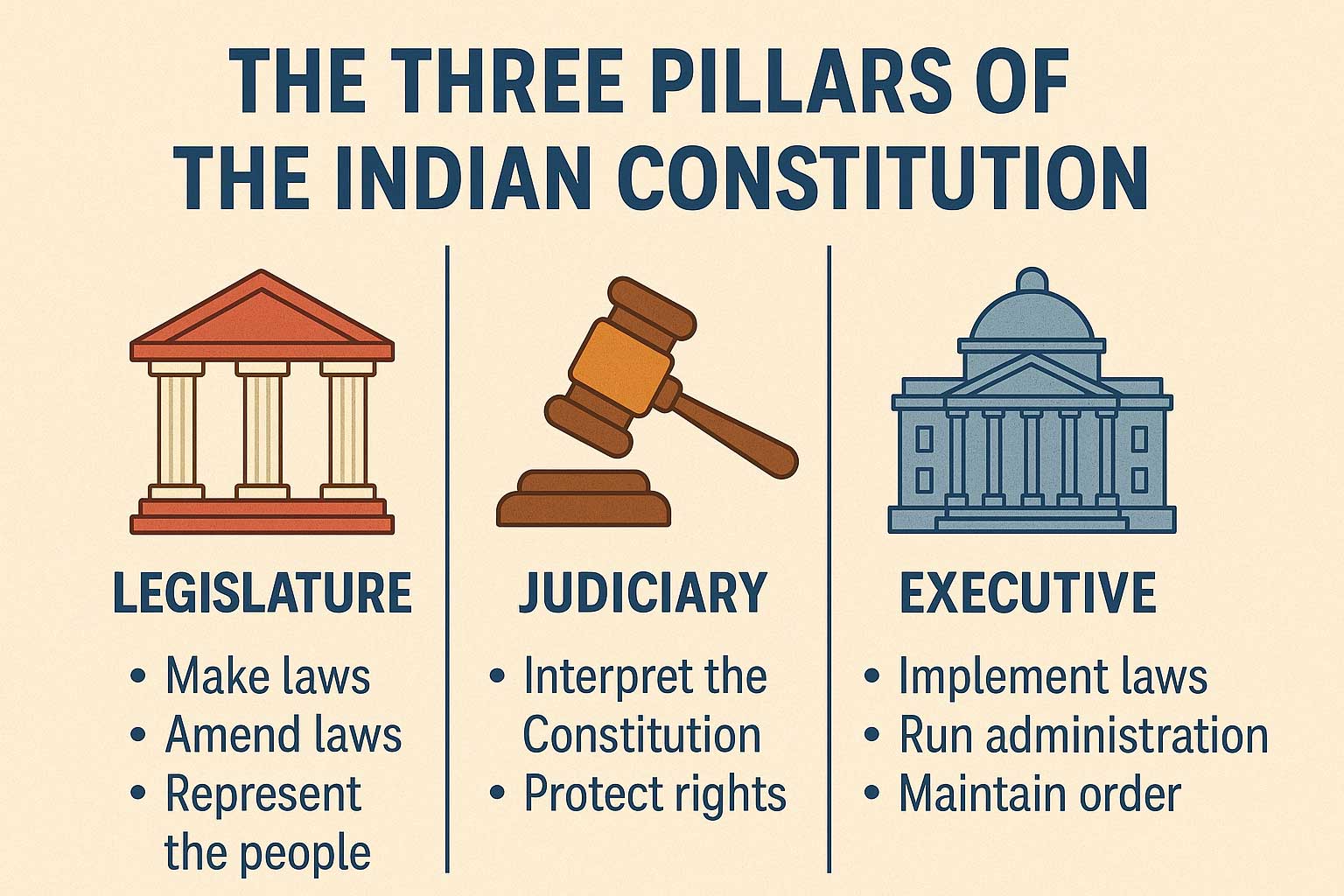
  • 🇮🇳 The Three Pillars of the Indian Constitution: The Power Trio That Runs India

    🇮🇳 The Three Pillars of the Indian Constitution: The Power Trio That Runs India

    If the Indian Constitution were directing a movie, it would proudly introduce its three superstar leads:

    The Legislature
    ⚖️ The Judiciary
    🏛️ The Executive

    Together, these three form the mighty Trinity of Indian Democracy, each with its own role, powers, and responsibilities—like the Avengers, but with fewer costumes and more paperwork.

    Let’s break them down in a fun and super-simple way!


    🏛️ 1. The Legislature – The Law-Makers (a.k.a. “The Think Tank”)

    Think of the Legislature as the group that decides:
    “What rules should the country follow?”

    🔹 Who Are They?

    • Parliament (Lok Sabha + Rajya Sabha)
    • State Legislatures (Vidhan Sabha & sometimes Vidhan Parishad)

    🔹 What Do They Do?

    • Make new laws 👨‍💼✍️
    • Change or remove old laws
    • Approve budgets 💰
    • Question the government (the Executive)
    • Represent the people’s voice

    🔹 Why Are They Important?

    Without the Legislature, we’d have chaos.
    Imagine driving without traffic rules—every day would be like a Fast & Furious movie.


    ⚖️ 2. The Judiciary – The Law-Interpreters (a.k.a. “The Referee”)

    If laws are the rules of the game, the Judiciary is the referee who ensures fairness and stops foul play.

    🔹 Who Are They?

    • Supreme Court
    • High Courts
    • District & other subordinate courts

    🔹 What Do They Do?

    • Interpret the Constitution 🧐
    • Protect fundamental rights
    • Stop unconstitutional laws
    • Settle disputes between states, people, and the government
    • Act as the final guardian of justice

    🔹 Superpower: Judicial Review

    Courts can say:
    “This law breaks the Constitution—REJECTED!”

    Like a teacher striking out a wrong answer in bright red ink.


    🏢 3. The Executive – The Law-Implementers (a.k.a. “The Action Team”)

    These are the people who make sure everything actually happens on the ground.

    🔹 Who Are They?

    • President
    • Prime Minister & Cabinet
    • Government departments
    • Police, civil services, district officers, etc.

    🔹 What Do They Do?

    • Run day-to-day administration
    • Implement laws created by the Legislature
    • Maintain law and order 🚓
    • Handle foreign affairs
    • Launch government schemes
    • Manage public welfare

    🔹 Why They Matter

    Imagine if laws existed but nobody enforced them.
    It would be like having house rules but no one to stop your sibling from stealing TV remote.


    🤝 How They Work Together (Without Fighting… Most of the Time)

    The beauty of Indian democracy is “checks and balances.”

    • Legislature makes the laws
    • Executive enforces the laws
    • Judiciary reviews the laws

    No one can become too powerful—just like a perfect team where everyone knows their job and nobody tries to be the boss of everyone else.

    Dr. Ambedkar called this “the heart of democracy”.


    🎉 Conclusion: The Three Pillars Keep India Standing Tall

    The Legislature thinks,
    the Executive acts,
    and the Judiciary keeps everyone in line.

    Together, they ensure that India remains a vibrant, democratic, rule-of-law-based nation.

    Our Constitution didn’t just create three pillars—
    it built a structure where power is shared, balanced, and accountable.

    And that’s what keeps India’s democracy alive!

  • 🇮🇳 Indian Constitution The Living, Breathing Guidebook of Our Democracy

    🇮🇳 Indian Constitution The Living, Breathing Guidebook of Our Democracy

    If the Indian Constitution were a person, it would definitely be the cool grandparent — wise, experienced, but still trendy enough to understand Instagram reels, AI, and cyber laws.
    Why? Because unlike a rigid old rulebook gathering dust on a shelf, our Constitution changes, adapts, and grows. It truly lives.

    Let’s dive into why the Constitution of India isn’t just a legal document — it’s a lively, evolving companion that walks with society through every stage of its journey.


    🌱 What Does “Living Document” Even Mean?

    In simple words:
    A living document is one that changes with time — not like your school timetable, but more like your phone’s software updates. 🔄

    Justice Oliver Holmes once said, “The life of the law has not been logic; it has been experience.”
    And the Indian Constitution is the perfect example — always learning, always adapting.


    👶➡️👨‍🦳 From 1950 to 2025 — A Journey of Evolution

    When our Constitution came into force in 1950, India was a newly independent nation with big dreams and even bigger challenges. But did the framers think India would one day deal with cyber-crimes, same-sex marriage debates, and data privacy issues? Probably not.

    Yet the Constitution still works beautifully.
    Why? Because it allows amendments, judicial interpretation, and flexible governance.

    Some cool examples:

    • 🧒 Right to Education (RTE) was added in 2002
    • 🔐 Right to Privacy became a fundamental right in 2017
    • 🏳️‍🌈 Section 377 overturned in 2018
    • 🗳️ Voting age lowered from 21 to 18
    • 👩‍⚖️ Basic Structure Doctrine ensures Parliament can’t just rewrite the Constitution casually

    Each of these shows the Constitution’s ability to evolve with changing social values.


    ⚖️ The Judiciary: The Constitution’s Personal Trainer

    If the Constitution is a living being, then the Supreme Court is its yoga coach, helping it stay flexible by interpreting it progressively.

    Some epic cases that shaped India:

    🔹 Kesavananda Bharati (1973)

    The Court said: “Change is fine, but don’t mess with the soul of the Constitution!”
    This gave birth to the Basic Structure Doctrine.

    🔹 Maneka Gandhi Case (1978)

    Turned Article 21 (right to life) into a powerhouse of rights — dignity, fairness, liberty, due process… basically the whole buffet.

    🔹 Puttaswamy Case (2017)

    Declared Right to Privacy a fundamental right — crucial in today’s digital age.

    🔹 Navtej Singh Johar (2018)

    Decriminalized same-sex relationships. A landmark in equality and dignity.

    These judgments show how the Constitution adapts without changing its core values.


    🧬 Why Do We Call It a Living Document?

    Because it…

    Grows with society

    From zamindari abolition to AI ethics, it covers everything.

    Balances stability & change

    You can’t change it casually — but you can when needed.

    Responds to people’s aspirations

    Social justice, human rights, equality — the Constitution keeps evolving to reflect modern India.

    Stays relevant across generations

    Your grandfather’s India and your India may be different, but the Constitution works for both.


    💬 A Beautiful Thought

    Granville Austin, a noted historian, called the Indian Constitution
    “a seamless web of principles — of social revolution and of unity and integrity.”

    Even today, that web keeps expanding, stretching, and strengthening — just like a living organism.


    🎉 Conclusion: The Constitution Isn’t Just Alive — It’s Thriving

    The Indian Constitution is not a museum artifact. It is a dynamic, adaptable, ever-evolving guide that grows with us.
    It protects our rights, balances power, corrects injustices, and supports new social realities — from gender identity to digital freedom.

    A document that continues to learn is truly alive.

    And that’s why the Indian Constitution remains one of the most respected, admired, and resilient constitutions in the world. 🌏✨